

Where Bright Ideas
Come to Life!
Come to Life!
MCB stands for Miniature Circuit Breaker which is an electromechanical device designed to protect an electric circuit from over-current. This is the technical term to describe an electrical fault caused by either overload or short circuit.
Prior to the 1960/70’s this over-current was protected by using fuse wire, (and there are still a number of Fuse Boxes around protected by Fuse Wire).
It was a simple method of protection an over-current would quite literally, 'blow' a piece of fuse wire in a cradle / cartridge by rapidly heating and melting it, eventually or even immediately breaking the electrical connection, the result of this in doing so, protected the rest of the electrical circuit. The piece of fuse wire was then replaced, by removing the cartridge, and un-screwing some of the old wire out of the terminals, and very carefully, often under a large magnifying glass a replacement piece of fuse wire was inserted and screwed into place. If there was a fault condition within the circuit, the fuse wire would often blow out, when the rewired fuse carrier was replaced so the whole procedure had to be repeated.
MCBs have improved on this functionality as they are usually not destroyed during over-current so are reusable. They are also much easier to use, offering the convenience of 'on/off switching' for circuit isolation and since the conductor is housed within a plastic casing, they are much safer to use and operate.
It is important to note that MCBs do not protect people against electrical shock caused by this'earth leakage'. This is provided by RCDs and RCBOs.
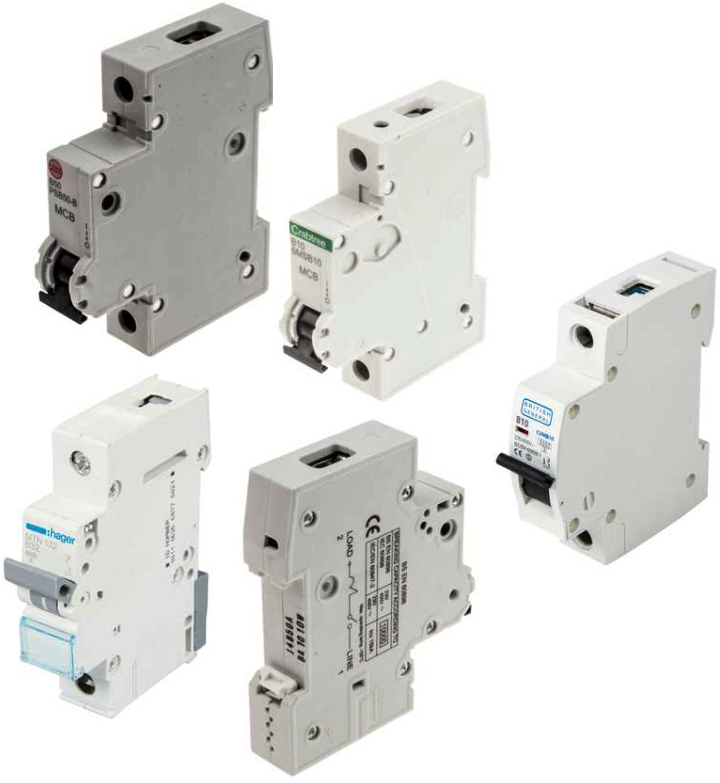
The MCB has three technical characteristics, Amperes (Amps /A), Kilo Amperes (kA) and Tripping Curve
Overload Current Rating - Amperes (A)
The overload occurs when there are too many appliances which are put onto one circuit and draw more electrical current than that circuit and cable are designed to take. This could occur in the kitchen, for example when the kettle, dishwasher, electric hob, microwave and blender are all in use simultaneously. The MCB on this circuit cuts power thus preventing overheating and fire in the cable and terminals. Although when installing new circuits for areas such as kitchens we have to look at diversity, a term used where there can be a lot of appliances plugged in with an amperage higher than the circuit will permit, however not all of the appliances will be drawing for current at any one time. You may be interested to know that we can get the “Christmas Day Scenario “where there is a lot of activity in the kitchen, additional friends and family are helping you with the food preparation, and a lot of appliances are switched on and being used at the same time. A solution for this is to not use everything at the same time!
Short Circuit Rating - Kilo Amperes (kA)
A Short Circuit is the result of a fault somewhere in the electrical circuit or appliance and is potentially much more dangerous than overload as the scale and speed of over current is in a different order of magnitude. This occurs when there is a direct connection between the live and neutral conductors in the circuit, or even within the appliance. Without the resistance provided by the normal circuit integrity, electrical current rushes around the circuit in a loop and multiplies the amperage by many thousand times in just milliseconds. This can occur when there is loose terminations and wires have fallen out within sockets and appliances, we can also find this where there has been water spilt or a slug or mouse has crossed the terminals. (They are frazzled to death, and you are left without electricity).
Check out our "Over Load Calculator"
MCBs used in domestic installations are typically rated at 6kA or 6000 amps. The relationship between normal voltage (240v) and typical domestic appliance power ratings mean that the over-current caused by short circuit should not exceed 6000 amps. In commercial and industrial situations however, using 415v and large machinery, it is necessary to use 10kA rated MCBs. These ratings signify the maximum Prospective Fault Current (PFC) that the MCB can withstand and still operate correctly by disconnecting the circuit. Should the PFC be exceeded, the MCB could fail resulting in the contacts welding shut.
For further Information, please do not hesitate to contact us.
Telephone: 01892 531728
"In June 2018 Karen and one of her team fitted some new lights in my kitchen ceiling. I was really pleased with the work. The job was done efficiently and tidily. I was kept informed of arrival time and I was impressed with the service I received. Thanks for a great job. Lucy"
Karen arrived shortly after my phone call, all sorted. Very happy, thank you.
"I have had Bright Sparks at my property twice in the last six months to complete some electrical work. I have been blown away by the innovative efficient way I am communicated with the efficiency and ease of the process. The work has been carried out to a more than satisfactory standard and I found it to be extremely competitively priced. It is by far the best experience I have had with any service provider in forever. Thanks guys."
Karen and her team provide a very efficient, friendly and pro-active service with a smile! We would not hesitate in recommending Bright Spark and fully intend to use them in the future for our electrical requirements."
I needed a job done really 'sooner rather than later' and at a weekend too! Karen came out, assessed what needed to be done and set to work straight away. Job done, cleared up and on her way within the hour! Not often you get that service! Certainly will keep her number on my mobile and recommend to anyone who needs an electrical job done!